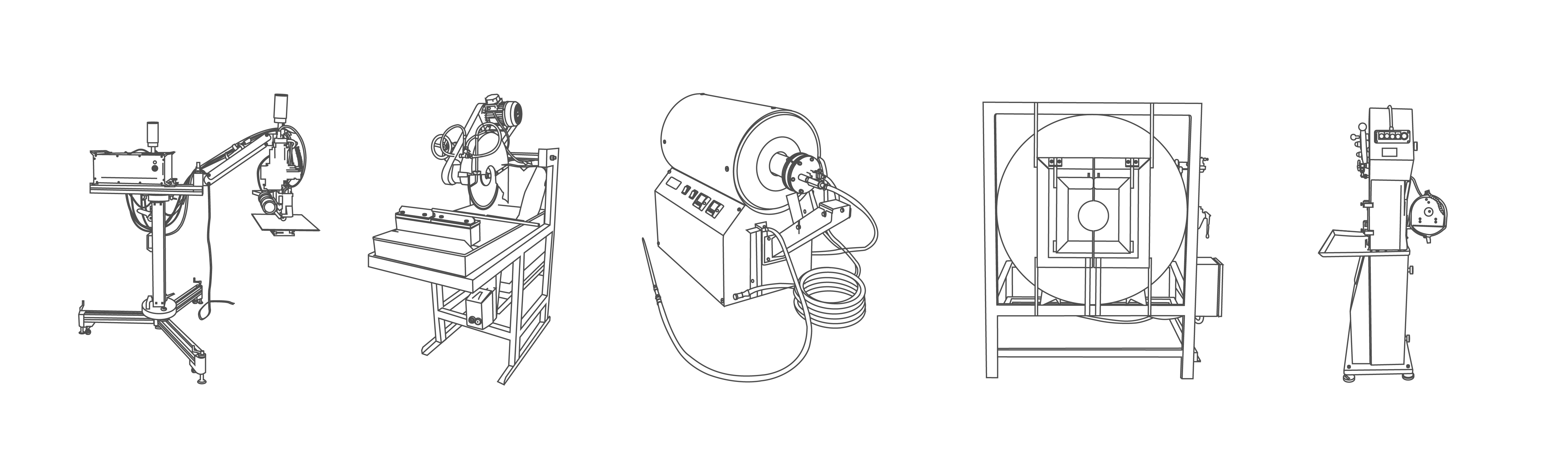
Glass and ceramic studios and laboratories of VICARTE at FCT-NOVA campus are equipped with:
Melting glass, firing ceramics, and designing new and innovative tools for discovery in the laboratory and studio demand that practice and theory be woven together into the social and intellectual fabric of our contemporary university. VICARTE has developed one of the world’s leading centres for working with glass and ceramics, investigating materials and techniques from ancient times to the present, with an emphasis on hands-on engagement.
The transformational nature of the types of materials under investigation at VICARTE owes much to the transition and fusing characteristics that occur at high temperatures. This requires specialised equipment for processing, analysing, developing, preserving, and crafting this knowledge.
Studios and laboratories are intensely used by all senior and junior researchers and students of master’s and PhD programs. At VICARTE they all may find the necessary means to prepare, develop, manipulate and study the properties of glass and ceramic materials.

Glass Studios
Working with glass demands the control of precise methodologies and the use of specialized equipment and tools. In these studios, we have special areas for high-temperature techniques such as kiln casting, slumping, glass blowing and lampworking. Other areas are dedicated to cutting, milling, grinding and polishing and glass painting or mold making.
These areas are equipped with gas furnaces for glass melting, glory holes, annealing kilns, bench work with torches, and all the tools needed. Furnaces used for fusing and melting in oxidizing and reduction atmospheres also allow the synthesis of glass compositions.

Ceramics Studios
Working with ceramics requires the knowledge and control of multiple processes, from making clay bodies to hand-building, drying, firing and recycling materials. VICARTE, Ceramic studios are equipped with the necessary equipment to carry out these processes, with a view to artistic creation and technological/scientific development, not only indoor but also outdoor, for raku or wood firing experiments. Like glass studios, ceramic studios have one area equipped with several high-temperature kilns to fire ceramic objects. Another area is more focused on the raw materials treatment, such as identification and granulometric separation, and on glaze application.

Characterization Equipment
Our research is supported by the characterisation of the developed and studied materials. VICARTE offers the possibility to measure chemical, thermal, structural and optical properties using various scientific equipment such as optical microscopes, high-power illumination sources, Optical Fiber UV/VIS Spectrophotometers, Hyperspectral camera, Differential Scanning Calorimeter, Dilatometer, as well as micro-Raman, micro-XRF and micro- FTIR spectrometers.

Conservation Laboratories
The Department of Conservation and Restoration also provides spaces and equipment that are made available to VICARTE, including a Laboratory for Biodeterioration and Preventive Conservation Research, Conservation-Restoration of Glass and Ceramics and Conservation and Restoration of Stained glass.
Furthermore, VICARTE’s research in Cultural Heritage implies different methodological approaches which include in situ analysis performed at cultural institutions and laboratory analyses performed on artworks or samples. A significant part of VICARTE’s research in Cultural Heritage is performed in situ. This implies the transportation of equipment to be used in fieldwork analyses and the added associated costs.
 VICARTE